AI Censorship Fact-Check Going into Effect July 1st
원본 (Korean)
Translation + Context
FT = ForbiddenTome — tap to see Korean slang explained
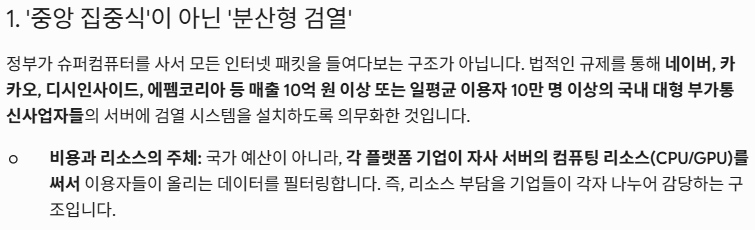
"Decentralized" censorship rather than "centralized"
It's not a structure where the government buys a supercomputer and looks into all internet packets. Through legal regulations, it mandates the installation of censorship systems on the servers of major domestic value-added telecommunications operators—such as Naver, Kakao, Dcinside, and FM Korea—with annual revenues of 1 billion won or more, or daily average users of 100,000 or more.
The subject of costs and resources: Rather than the national budget, each platform company uses their own server's computing resources (CPU/GPU) to filter data uploaded by users. In other words, it's a structure where companies each bear their own share of the resource burden.
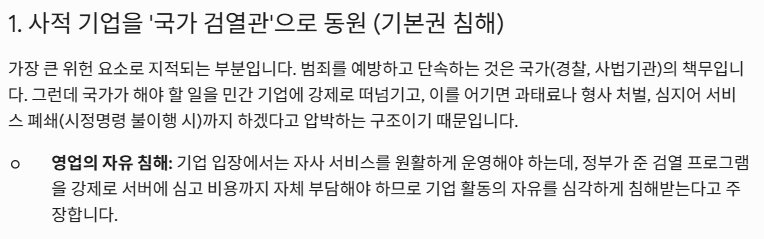
Mobilizing private enterprises as 'state censors' (violation of basic rights)
This is pointed out as the biggest unconstitutional element. It's the state's (police, judicial authorities) responsibility to prevent and crack down on crime. But the state is forcing private companies to do what they should be doing, and if they refuse, they're pressuring them with fines, criminal punishment, and even service shutdown (if they don't comply with corrective orders). That's the structure of it.
Violation of business freedom: From the company's perspective, they need to operate their services smoothly, but the government is forcing them to install a censorship program on their servers at their own cost, so they argue that their freedom of business activity is seriously violated.
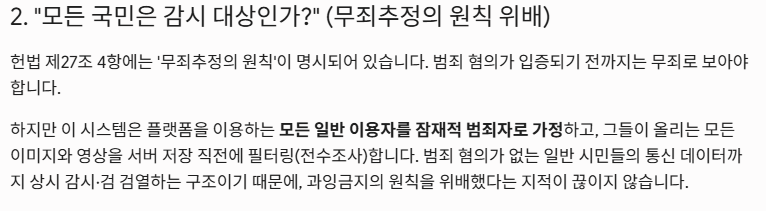
"Are all citizens under surveillance?" (Violation of the Presumption of Innocence) Article 27, Section 4 of the Constitution explicitly states the 'Presumption of Innocence.' Until criminal allegations are proven, one must be presumed innocent.
However, this system assumes all general users of the platform as potential criminals and filters (conducts a full survey of) all images and videos they upload right before server storage. Because it's a structure that constantly monitors and censors communication data of ordinary citizens without criminal allegations, there are continuous criticisms that it violates the principle of prohibition of excess.
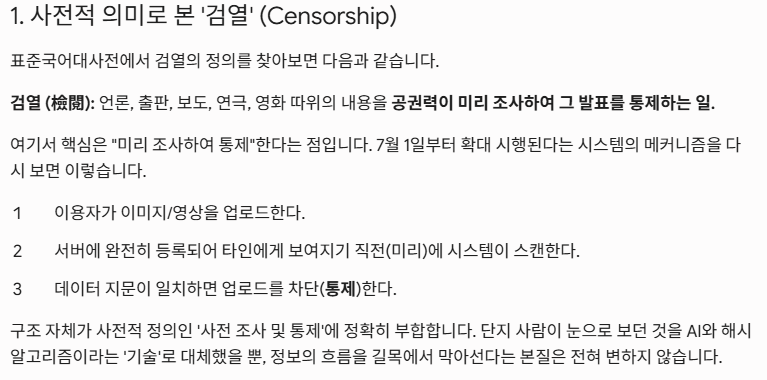
'Censorship' from a Dictionary Definition
Looking up the definition of censorship in the Standard Korean Dictionary, it goes like this:
Censorship (檢閱): The act of the state exercising public authority to pre-examine the content of press, publications, reports, plays, films, etc., and control their publication.
The key point here is "pre-examining and controlling." Looking at the mechanism of the system that's being expanded from July 1st, it's like this:
A user uploads an image/video.
Right before it gets completely registered on the server and shown to others (pre-emptively), the system scans it.
If the data fingerprint matches, the upload is blocked (controlled).
The structure itself perfectly aligns with the dictionary definition of 'pre-examination and control.' They simply replaced what humans used to check with their eyes with 'technology' like AI and hash algorithms, but the fundamental nature of blocking information flow at the gateway hasn't changed at all.
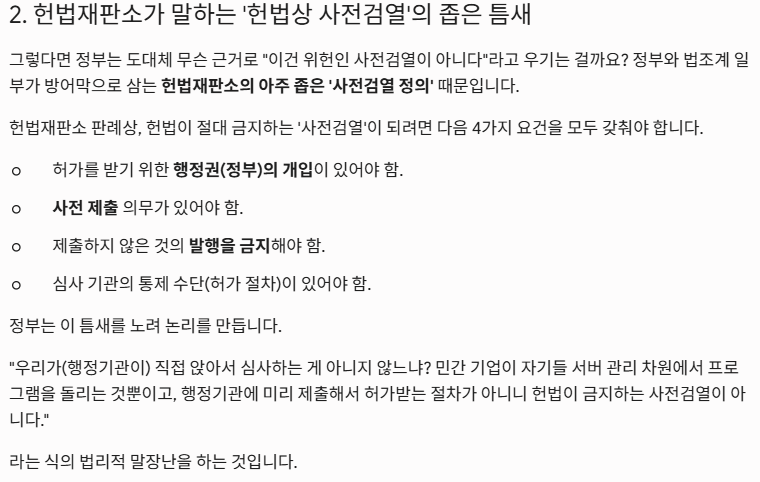
So then, what in the world is the government's basis for insisting "this isn't unconstitutional prior restraint"? It's because of the Constitutional Court's extremely narrow definition of 'prior restraint' that the government and some in the legal community use as a shield.
According to Constitutional Court precedent, to qualify as 'prior restraint' that the Constitution absolutely prohibits, it must meet all four of the following requirements.
° There must be involvement of executive power (the government) in obtaining permission. There must be an obligation to submit in advance. Publication of materials that aren't submitted must be prohibited. ° There must be control measures (permission procedures) by the reviewing body.
The government creates logic by exploiting this loophole. "We (administrative agencies) aren't directly sitting down to review it, are we? Private companies are just running programs as part of server management, and it's not a procedure of submitting to administrative agencies in advance and getting permission, so it's not constitutionally prohibited prior restraint."
They're engaging in this kind of legal wordplay.
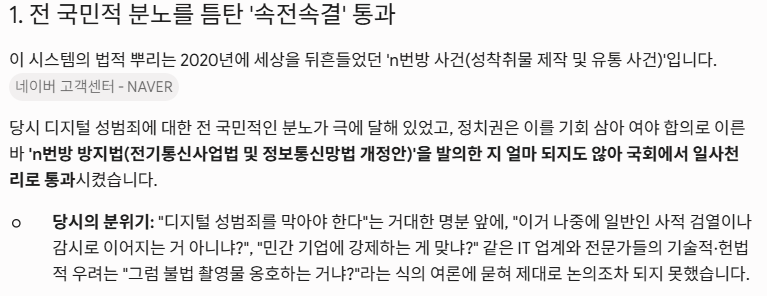
'Quick Resolution' Passed by Exploiting National Outrage
The legal foundation of this system comes from the 'Room N incident (production and distribution of sexual exploitation material)' that shook the nation in 2020. Naver Customer Center - NAVER
At the time, national anger over digital sex crimes had reached its peak, and the political sphere seized this opportunity to push through what's called the 'Room N Prevention Act (amendments to the Telecommunications Business Act and Information and Communications Network Act)' through the National Assembly at lightning speed with bipartisan agreement.
The atmosphere at the time: In front of the grand justification of "we must stop digital sex crimes," concerns from the IT industry and experts about the technical and constitutional issues—"Won't this lead to civilian surveillance and censorship of private citizens later?" and "Is it right to force private companies to do this?"—were buried under public opinion along the lines of "So you're defending illegal filming videos?" and never properly discussed.
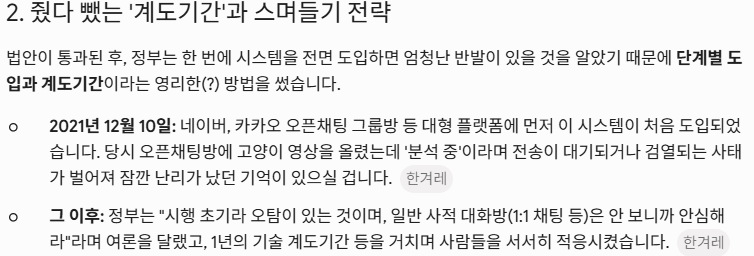
The "grace period" they gave and took away, and the strategy of gradually seeping in
After the bill passed, the government knew there would be massive backlash if they implemented the entire system all at once, so they used a clever(?) method of phased rollout and a grace period.
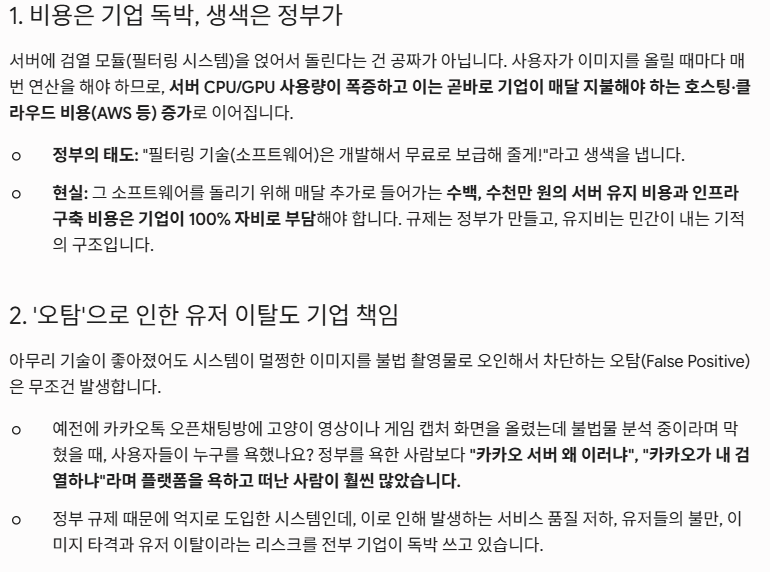
The cost is on the company, the credit goes to the government. Running a censorship module (filtering system) on the server isn't free. Every time a user uploads an image, the system has to process it, which causes server CPU/GPU usage to skyrocket and directly leads to increased hosting and cloud costs (AWS, etc.) that the company has to pay every month. The government's attitude: "We'll develop the filtering technology (software) and distribute it for free!" taking credit for it. Reality: The company has to bear 100% of the hundreds of millions of won in monthly server maintenance costs and infrastructure setup costs needed to run that software. It's a miraculous structure where the government makes the regulations and the private sector pays the bills.
User churn from "false positives" is also the company's problem. No matter how good the technology gets, the system will inevitably produce false positives where it mistakes legitimate images for illegal content and blocks them. Remember when people uploaded cat videos or game screenshots to KakaoTalk open chat rooms and they got blocked saying "analyzing illegal content"? Who did users blame? Way more people blamed the platform saying "Why is KakaoTalk's server like this?" or "KakaoTalk is censoring me" and left, rather than blaming the government. It's a system forced upon them because of government regulations, but the company is left holding the bag for all the risks—service quality degradation, user complaints, brand damage, and user churn that result from it.
1. Can the South Korean government handle the traffic?
No: The government is forcing companies to adopt the censorship system—the companies absorb the traffic costs.
2. Isn't the censorship itself unconstitutional?
No: The censorship itself isn't unconstitutional, but outsourcing it to private companies raises constitutional red flags.
3. Deletions are just being "reviewed," so it's not really censorship?
No: Controlling content itself is literally what we call censorship.
3-2. Then how did this even pass the judiciary?
man, I have no clue either;
4. We don't remember ever agreeing to this—why is it being rushed through like this?
No: You already implicitly agreed—you're just keeping quiet because society bullied you into it.
5. So do companies handling the traffic get anything out of it?
No: hell no
Bonus thought: Genuinely asking—people upvoting this just hate the idea of AI moderation period, right...? Right...?

Naver LINE Taken Over by Japan: Here's What It Looks Like Now
104223 months agoby perkygoat215271
That Millionaire Said You Could Make $1B a Year Just by Working Hard
53133 months agoby sunnysloth473196
Chef Lim's Latest Update
9693 months agoby bouncybunny707967
Idol who frequently uses regional dialect ending "-no" like Loona's Won
147293 months agoby gleefulduck689593
Why That Rental Escort Manga is Creepy as Hell
129164 months agoby breezyquail332258
"Women should just marry Chinese guys..." .jpg
108134 months agoby bouncybunny707967
Why Park Su-hong Got Mad.jpg
72134 months agoby merryotter495433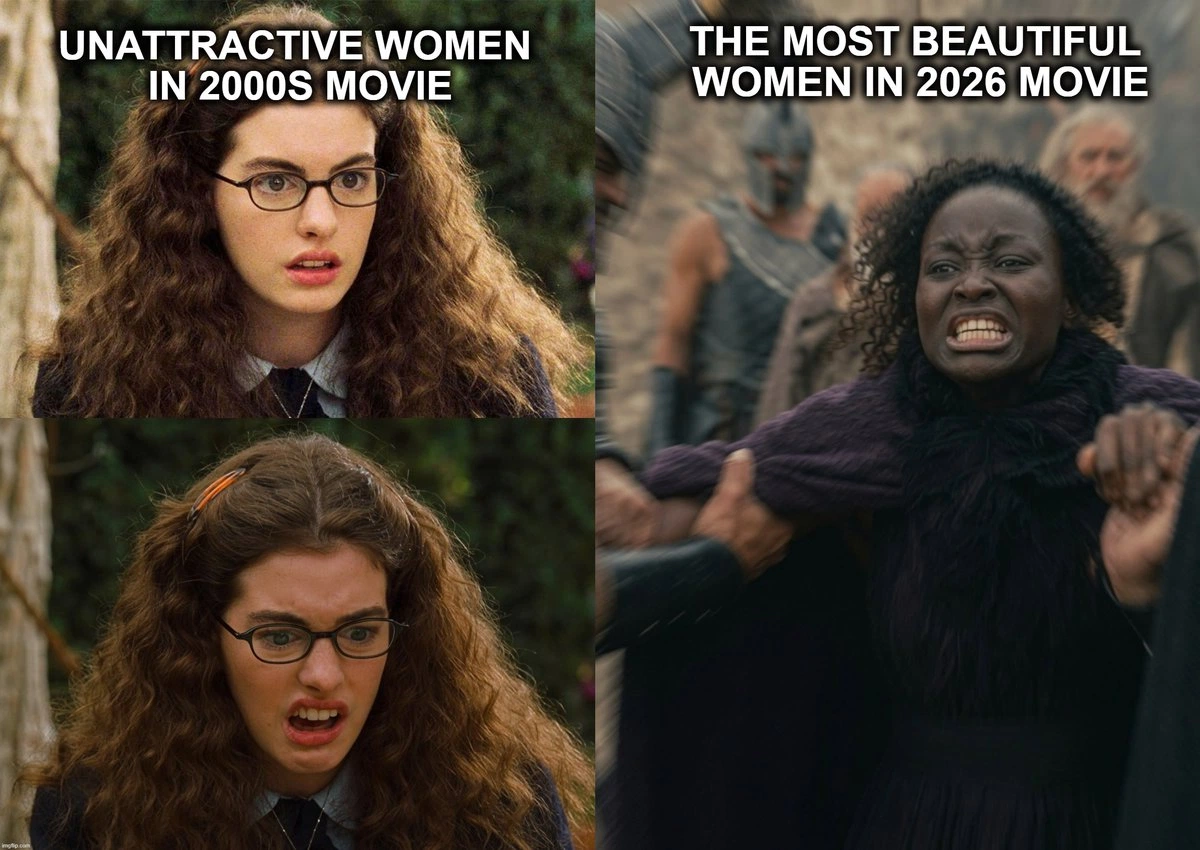
Ugly duckling from 20 years ago vs. the fairest of them all at 26
74204 months agoby zippycat886001
Lychee One's causing such a scene they're making news on Ilbe lol
117144 months agoby cheerynewt745728
The Legendary Case That Ended Britain's Death Penalty.jpg
85204 months agoby warmcrane288038
The "most Korean airport ever" — Daegu Airport..jpg
9084 months agoby bouncymole802682
Breaking: Tibetan self-immolates after independence appeal speech in front of UN headquarters in New York
69234 months agoby cheeryhawk845757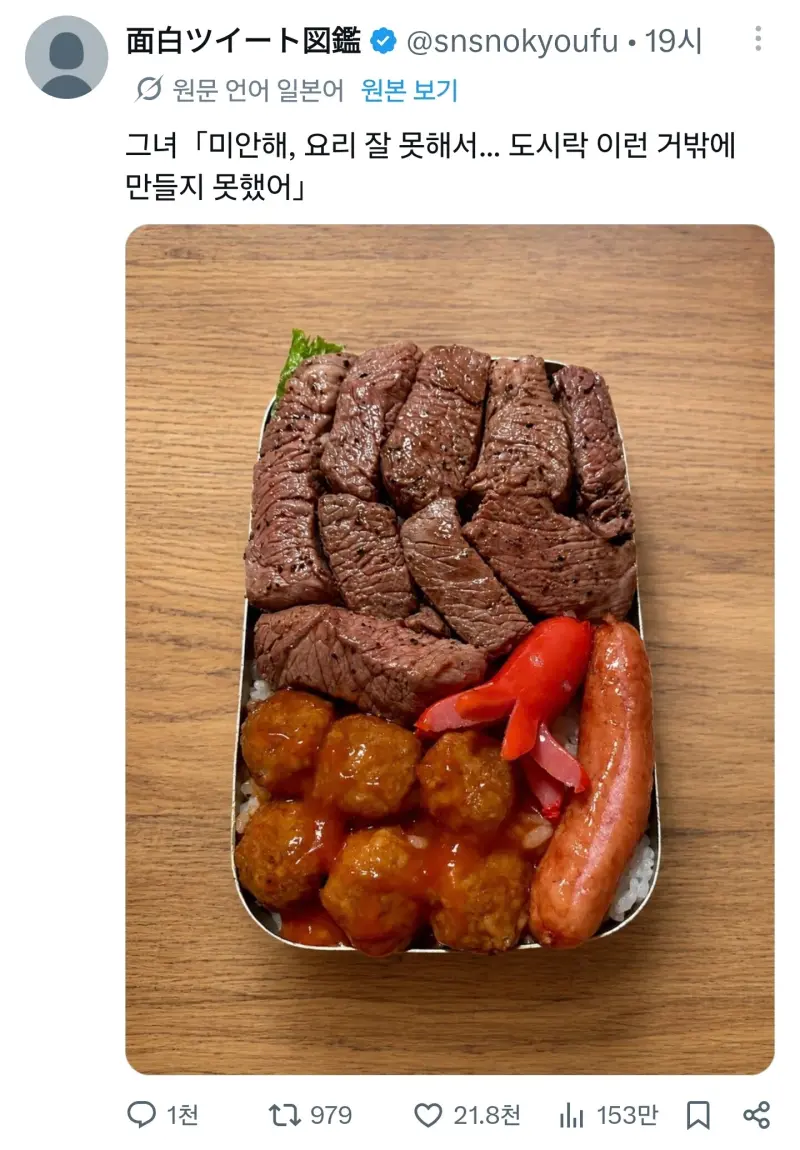
My girlfriend can't cook
66144 months agoby bouncyquail684074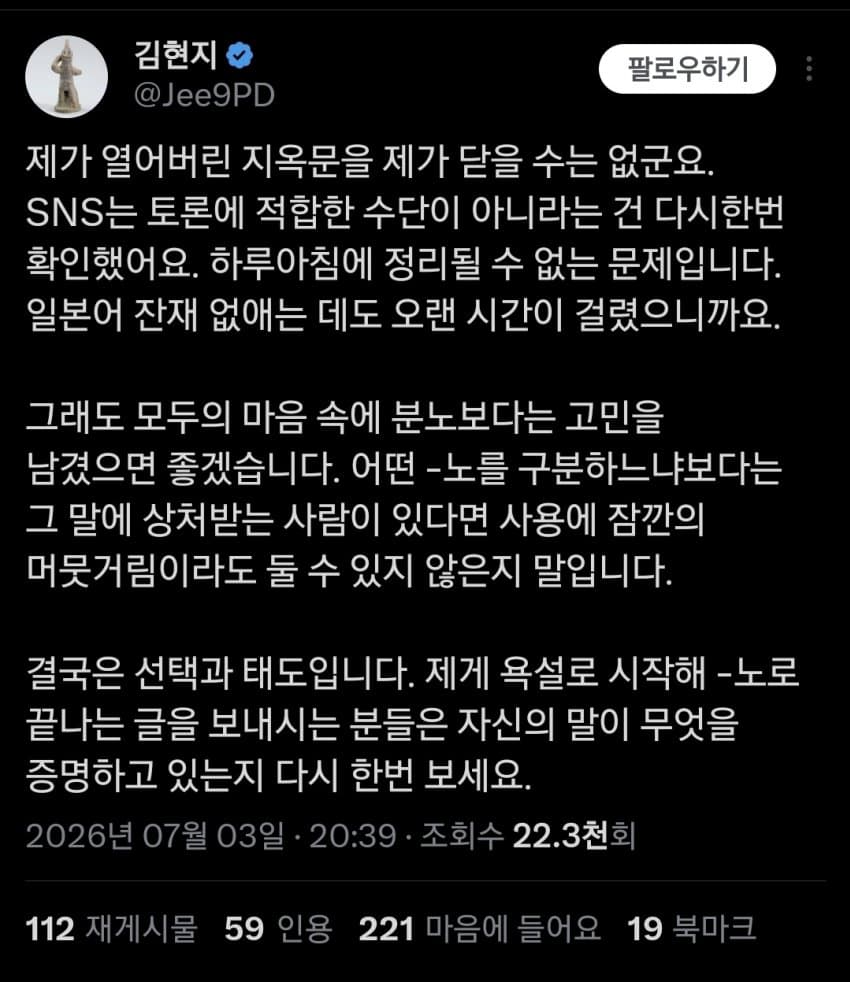
MBC PD accused of feminist bias responds after being called out by rookie broadcaster
109154 months agoby sparklycat992291
The 32-Year-Old Game Developer on a Romance Show.jpg
11174 months agoby sparklyhawk574545
Why Toss Is Still Better Than Traditional Banks
87144 months agoby sunnywolf124774
Whatever You Mock Will Definitely Happen to You
109144 months agoby goldenpanda590494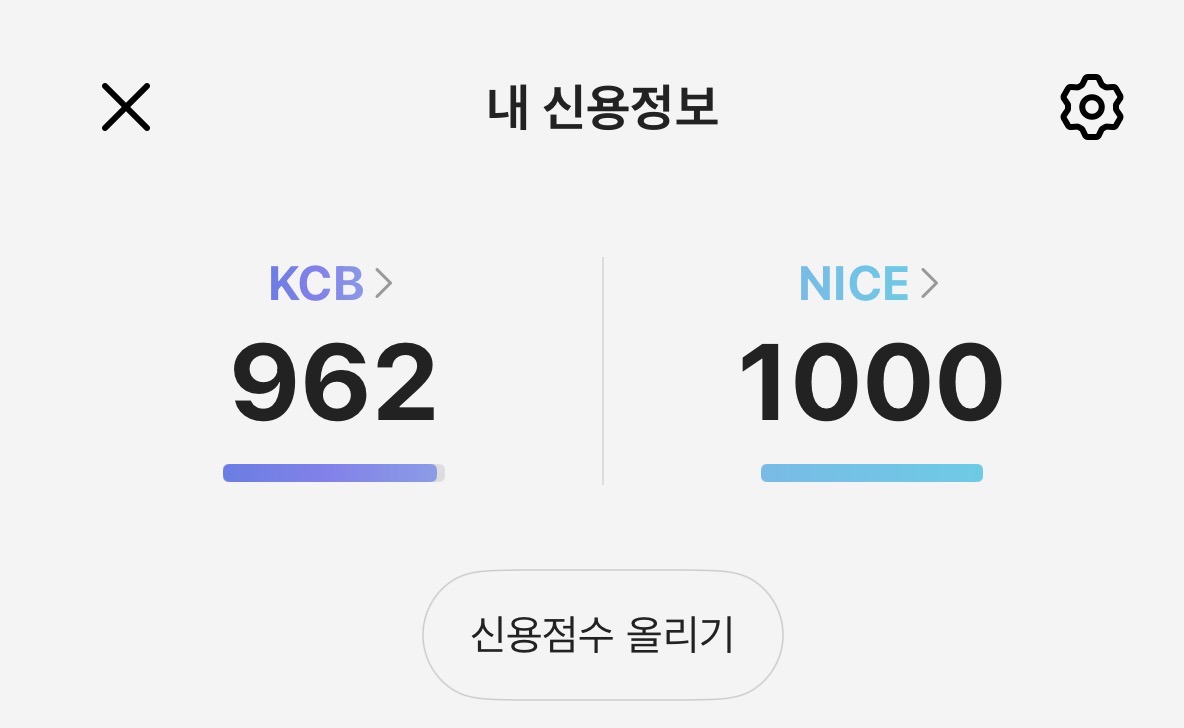
Finally hit a perfect credit score after years of financial hell
96144 months agoby sunnyfox985462
An Underrated all-time Tax Scam Case...jpg
150204 months agoby fluffyquail290233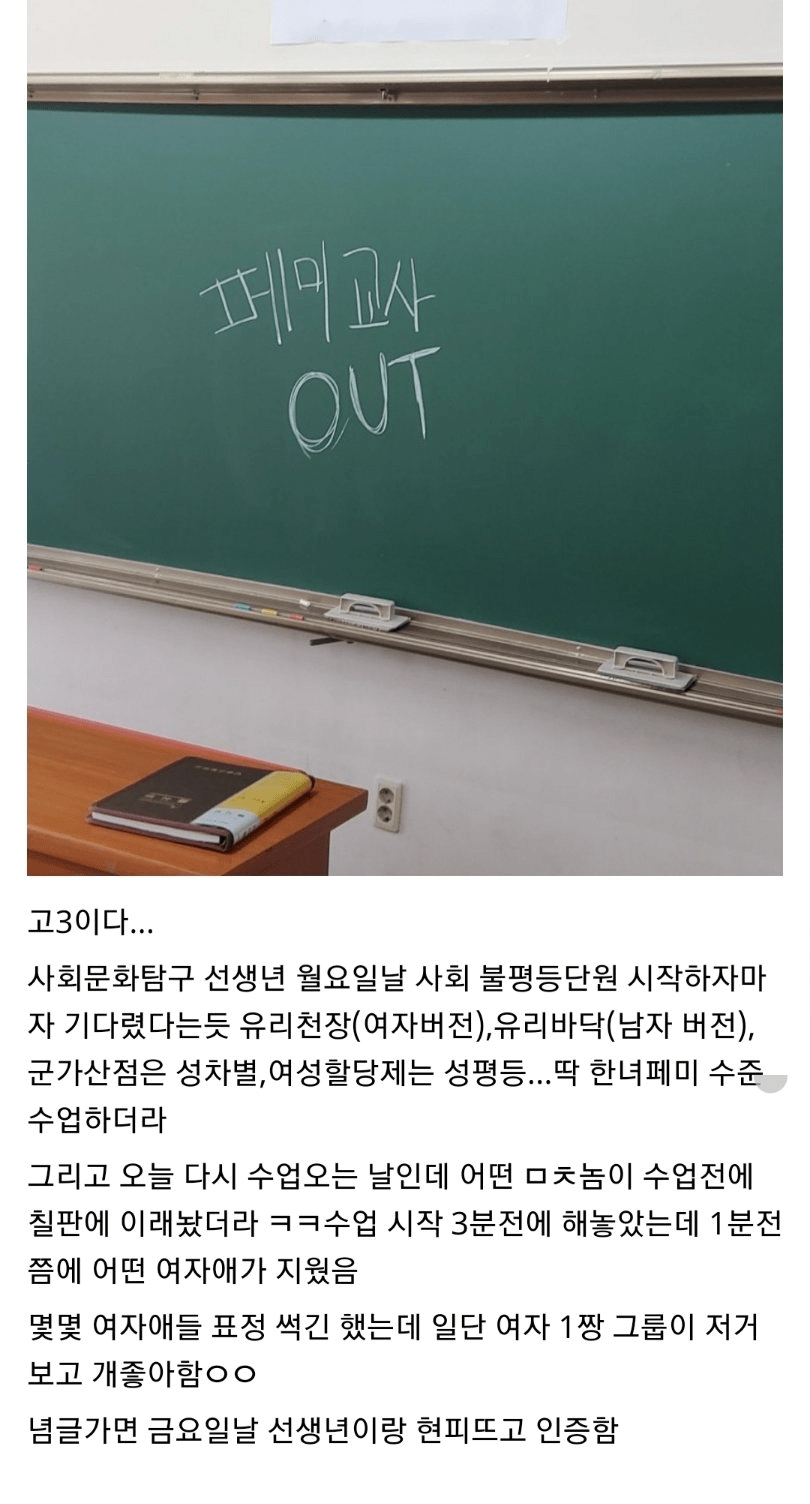
Anti-feminist tensions in a high school classroom
144144 months agoby perkyfox693854
13 comments
Damn AI moderation zealots
Making Korea into China project
Actually China doesn't even do this stuff—we're the ones pulling this?
You implicitly agreed, you're just silent because society overwhelmed you with pressure—like the whole 'you were silent when they persecuted the Jews' thing, and now when it's your turn nobody's gonna defend you. That was it
AI censorship: asking the AI to fact-check itself speedrun
this is either the best or worst thing I've heard all week and I can't decide which
anyone else reading this like... July 1st is literally next week in some countries 😅
Regulate communities to prevent incidents like Nth Room...? That makes no sense
Meanwhile, Telegram where actual crimes happen is where politicians and bigwigs have their hookups, so they don't regulate that lmaooo
They can't do it you idiots. Next they're probably gonna try cutting off Reddit or overseas SNS. Such a bullshit policy.
So dude, it's like 'murders happened with kitchen knives so we're banning kitchen knives'—tier stupid policy, except what's actually being applied is 'we can't regulate knives so we're banning chopsticks instead.' Seriously making me dizzy
The reason people upvote) Obviously it's a legit issue but they keep trying to force it through anyway
Criticizing AI censorship using AI and calling it 'fact-check' in the title is kinda pushing it, no?
This kills me lmaooo so next are all these people gonna come to work and be like 'the AI said so?' How are we even supposed to handle this???
Just copy-pasted what AI said and called it a fact-check lol
Real talk if you're calling it fact-checking, at least ask the AI for sources and attach them too—using AI like this is just stupid on the user's part too
wait so they're actually doing this? my vpn stocks are about to 📈
So when AI says that, you just copy-paste it straight? Or do you do cross-verification and additional research based on that?
Yeah right
lol finally some transparency, been wondering what's actually getting filtered
honestly if it stops the bots I'm here for it ngl
another 'fact-check' that's probably going to fact-check itself into oblivion, classic internet moment